What bollards cost installed
A standard concrete-filled steel pipe bollard set in a new concrete footing typically runs $425 to $850 installed per bollard in the Phoenix metro. Cost per unit drops meaningfully when several are installed in the same visit, since most of the expense is mobilization, coring and concrete rather than the pipe itself. Bundling bollards with a restripe removes a second mobilization charge.
Surface-mounted bollards bolted to existing concrete are cheaper — often $240 to $480 — but they offer far less impact resistance. They stop a shopping cart and mark a boundary. They do not reliably stop a vehicle.
Sleeve-over covers for existing bollards are the cheapest item on the list, generally $75 to $175 each installed, and they are a cosmetic fix for rusted pipes rather than a structural one. Removable bollards that lock into a ground socket typically run $550 to $950 installed.
Choosing the type
Four types cover almost every commercial application:
- Fixed embedded — concrete-filled steel pipe in a footing below grade. The standard for real impact protection at storefronts, gas meters and utility equipment.
- Surface-mounted — bolted to existing slab. Fast, cheaper, much lower impact rating. Suitable for wayfinding and light protection.
- Removable — locks into a ground socket and lifts out. For fire lane access points, loading areas and anywhere you occasionally need to let a vehicle through.
- Decorative sleeve or cover — a plastic or stainless sleeve over an existing pipe. Cosmetic only, but a cheap way to make a tired frontage look maintained.
When bollards are actually required
Protection of gas meters and certain utility equipment is commonly required by code or by the utility itself, and that requirement is enforced. Beyond that, most bollard installation is driven by insurance, by a property manager's risk assessment, or by an incident that already happened.
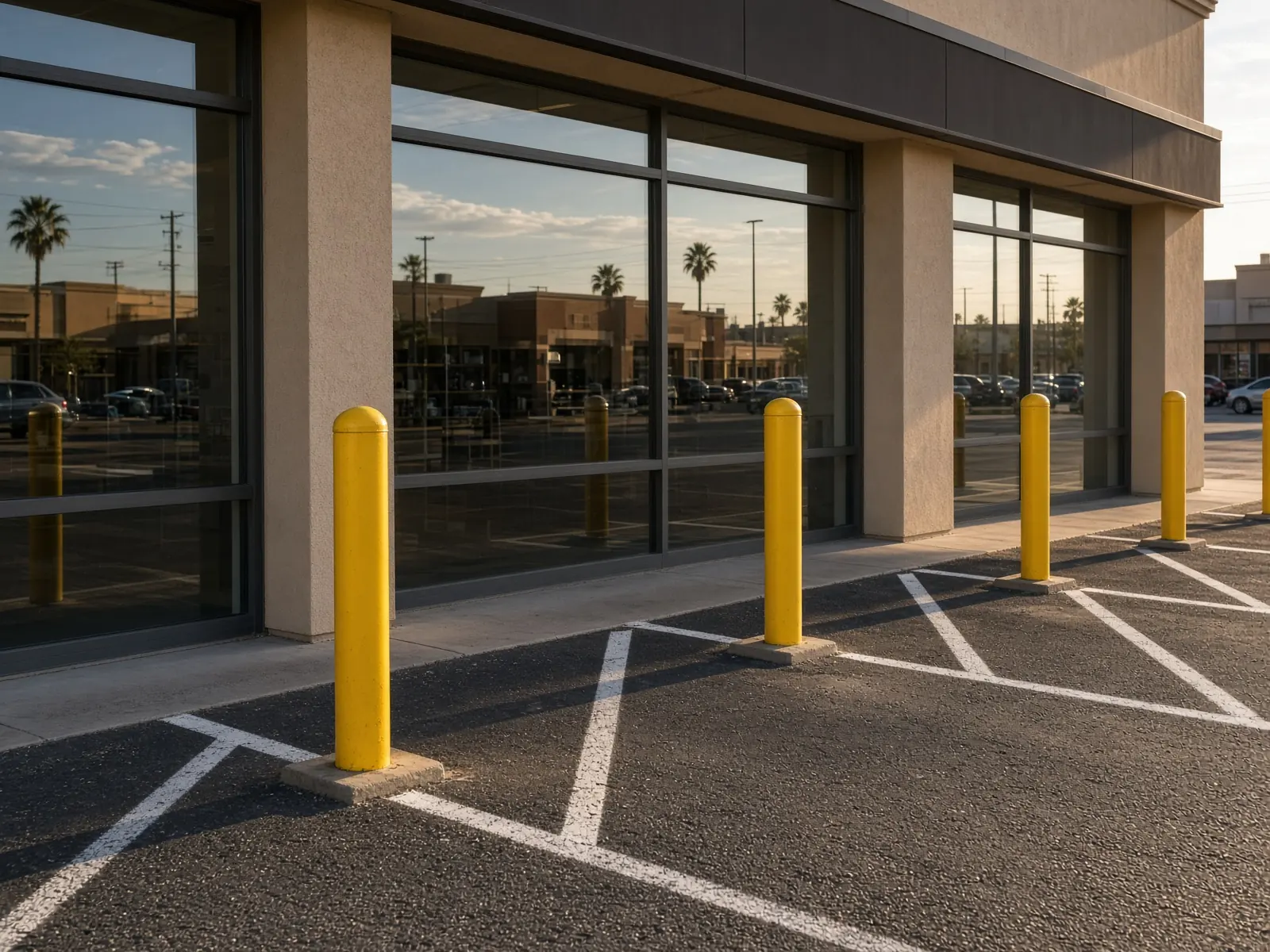
Storefronts with parking stalls facing the glass are the highest-risk configuration in a commercial lot, and the one where retrofitting bollards after the fact is most common.
What affects the price on your site
Coring through existing concrete versus setting in soil, depth of footing required, whether utilities have to be located before digging, pipe diameter and wall thickness, and finish — galvanized, painted or sleeved. Concrete cure time also means bollard work is usually a two-visit job if painting or sleeving follows.
Common questions
How deep does a bollard footing need to be?
It depends on the impact rating you need and the soil, but a typical fixed commercial bollard is set in a footing roughly a third to a half of the above-grade height. A bollard set shallow looks identical and provides almost no protection.
Can bollards be installed in existing asphalt?
Yes. The area is cored or cut, a concrete footing is poured, and the asphalt is patched around it. It costs more than setting in bare soil, and the patch is visible unless the lot is later sealcoated.
Do bollards need to be painted a specific color?
Safety yellow is the convention for visibility, and some settings require it. Where appearance matters, stainless or powder-coated sleeves are common — the protection comes from the pipe and footing, not the finish.